
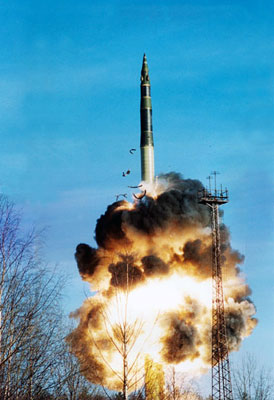
Die Wahrung der wechselseitigen Vernichtungskapazität zwischen den USA und Russland (Mutual Assured Destruction, MAD) zählt noch immer zu den Kernparametern russländischer Verteidigungspolitik. Trotz substantieller Steigerung der nominellen und realen Militär- und Verteidigungsausgaben Russlands seit 2001 (gemessen als Anteil am BIP sind die Ausgaben aber rückläufig) kann Russland sein derzeitiges nuklear bestücktes Raketenarsenal und die Zahl seiner operativen Nuklearsprengköpfe nicht aufrecht erhalten. Auch ist Russland die kostenintensive Lagerung nicht-operativer Sprengköpfe (hedging), die durch den SOR-Vertrag erlaubt ist, anders als den USA aus finanziellen Gründen nur begrenzt möglich. Russland wird daher gegenüber den USA sowohl bei den Trägersystemen, den operativen Sprengköpfen als auch bei den gelagerten, aber in kurzer Zeit reaktivierbaren Sprengköpfen deutlich zurückfallen.
Auch die strukturelle Schwäche der Streuung des Nukleararsenals auf ICBMs, SLBMs und Bomber, die bereits für das sowjetischen Nukleararsenal gegolten hat, wird sich bis auf weiteres nicht ändern: Russland wird seine Nuklearkapazität weiterhin vorrangig auf landgestützte ICBMs abstützen (müssen); die geringe Zahl seegestützter Interkontinentalraketen (SLBMs) wird auch in absehbarer Zeit erhalten bleiben. Das erhöht die Verwundbarkeit des russländischen Nukleararsenals gegenüber einem atomaren Erstschlag, die auch durch mobile ICBMs nur geringfügig abgesenkt werden kann.
Aber auch die Zahl der landgestützten russländischen Intercontinental Ballistic Missiles (ICBMs) nimmt seit Jahren ab. Russland will eine verschlankte aber hocheinsatzfähige landgestützte Nuklearkapazität aufrechterhalten. Die Strategischen Raketenstreitkräfte, die seit 2001 direkt dem Generalstab untergeordnet sind, verfügten 2006 über folgende ICBMs (die meisten Stückzahlen stammen von www.russianforces.org):
Ø 2006 waren noch 80 SS-18 ‚Satan’ (RS-20V Voevoda) stationiert. Russland hat die Einsatzbereitschaft der mit 10 Sprengköpfen (Multiple Independently-Targetting Reentry Vehicles, MIRVs) ausgestatteten, 1979 erstmals aufgestellten, SS-18 bis 2018 verlängert. Mit dieser ICBM sind damit 800 Sprengköpfe einsetzbar. Durch den Austritt Russlands aus dem Start-2 Vertrag (Juni 2002) nach der Kündigung des ABM-Vertrages durch die USA (Dezember 2001) war die Nutzung der MIRV-Technologie wieder erlaubt. Diese wurde auch durch den SOR-vertrag nicht wieder beseitigt.
Ø 2006 verfügte Russland über 126 SS-19 ‚Stiletto’ (UR-100 N-UTTČ) Die Einsatzbereitschaft der SS-19, die mit 6 MIRVs ausgestattet sind, wird bis 2030 gegeben sein. Die SS-19 wurde erstmals 1980 in Dienst gestellt. Über diese Rakete sind 756 nukleare Sprengköpfe einsetzbar.
Ø Russland verfügte 2006 noch über 252 mit einem Einfachsprengkopf bestückte, und 1985 erstmals in Betrieb genommene, SS-25 ‚Topol’ mit insgesamt 252 Sprengköpfen. Dieses bisherige Rückgrat des ICBM-Arsenals Russlands nähert sich rasch dem Ende der Einsatzfähigkeit; es wird in den nächsten Jahren sehr rasch reduziert werden (müssen).
Ø Das ambitionierte Programm zur Stationierung der 1997 erstmals aufgestellten SS-27 ‚Topol-M silo’ (RT-2PM2) – die die älteren Raketentypen wie SS-18, SS-19 und SS-25 schrittweise ersetzen soll – ist bislang durch finanzielle Restriktionen noch beinahe im Anfangsstadium. Die in Silos gelagerte Topol-M silo befördert eine Nutzlast von 1.2 Tonnen und ist derzeit nur mit jeweils einem Sprengkopf ausgerüstet; in den nächsten Jahren sollen die SS-27 aber mit MIRV-Technologie ausgestattet werden. Bis 2006 wurden 42 SS-27 mit einer Sprengkopfzahl von 42 stationiert.
Ø 2006 wird erstmals auch die mobile landgestützte Variante der Topol-M, die SS-27 ‚Topol-M mobile’ aktiviert. Bis Jahresende 2006 wurden 3 dieser Raketen mit insgesamt 3 Sprengköpfen stationiert. Geplant ist aber die Aufrüstung der landgestützten mobilen Topol-M auf drei IRVs. Ende 2006 waren damit nur 45 Topol-M Raketen stationiert. In einer Erklärung vor der Staatsduma am 14. Februar 2007 erklärte der damalige Verteidigungsminister Ivanov, 2007 sollen 17 neue und bis 2015 zusätzliche 69 Topol-M stationiert werden.
Die Strategischen Raketentruppen verfügten damit Ende 2006 über 503 ICBMs mit insgesamt 1.853 Sprengköpfen.
Die seegestützte Nuklearkapazität Russlands ist quantitativ schwächer ausgeprägt als das landgestützte ICBM-Arsenal. Russland war als Kontinentalmacht im Bereich der SLBMs immer deutlich schwächer ausgestattet als im Bereich der ICBMs – und damit auch strategisch verwundbarer, v.a. bei den silogestützten ICBMs. Der weitere Ausbau im SLBM-Bereich wird im nächsten Jahrzehnt v.a. aufgrund der technischen Schwierigkeiten mit der neuen SLBM Bulava und durch das Fehlen einer modernen U-Boot-Flotte gehemmt werden.
Die Strategische Flotte ist in die russländische Marine integriert. Dieser Einsatzverband verfügt derzeit über 14 einsetzbare strategische Nuklear-Unterseebote: 2 der Typhoon-Klasse (Dmitrij Donskoj, Archangelsk), 6 Delta IV und 6 Delta III. 1990 hatte die sowjetische Marine noch über 62 einsetzbare strategische U-Boote verfügt. Bereits für 2006 war ein neues strategisches nukleares U-Boot der fünften Generation, der Borej-Klasse angekündigt; diese ‚Jurij Dolgorukij’ befindet sich derzeit im Maschinenbaubetrieb Severodvinsk inmer noch im Bau. Bis 2010/12 sollen davon 3 in Dienst gestellt werden. Die neue Generation der strategischen U-Boote ist deutlich kleiner (Wasserverdrängung von 12.000 metrischen Tonnen, Typhoon-Klasse 25.000 mT), sie ist schwerer aufzuspüren und besser bewaffnet. Insgesamt sollen nach Angaben des Oberkommandierenden der Marine, Flottenadmiral Kurojedov, 12–15 derartige strategische U-Boote angeschafft werden.
Die Raketenbestückung der atomaren U-Boot Flotte besteht aus:
Ø 84 SS-N-18 SLBMs mit jeweils 3 Sprengköpfen; das ergibt insgesamt 252 operative Sprengköpfe.
Ø 96 SS-N-23 SLBMs mit jeweils 4 Sprengköpfen; dies sind insgesamt 384 Sprengköpfe.
Ø Seit 2004 testet die russländische Marine die neue SLBM SS-N-30 ‚Bulava’, deren Reichweite bei 10.000 km liegt. Die Rakete kann bis zu 10 einzeln lenkbare Sprengköpfe (IRVs) aufnehmen. Die Bulava SLBM sollte an sich 2007 eingesetzt werden, angesichts von drei fehlgeschlagenen Tests in 2005 und 2006 wurde die Kommissionierung aber verschoben.
Auf 180 seegestützten SLBMs hat Russland derzeit 636 operative Sprengköpfe stationiert.
Die luftgestützte Nuklearkapazität Russlands stützt sich auf drei verschiedene Bombertypen: Russland verfügte 2006 über 79 strategische Bomber: 15 Tupolev-160 (Blackjack), die sukzessive modernisiert werden, 32 Tu-95 MS6 (Bear H16) und 32 Tu-95 MS16 (Bear H16). Die strategischen Bomber tragen luftabgefeuerte Marschflugkörper des Typs AS-15A bzw. AS-15B und Angriffsraketen des Typs AS-16.
Insgesamt können mit der strategischen Bomberflotte 884 Marschflugkörper und Bomben eingesetzt werden.
Bilanz:
Russland verfügte mit Jahresende 2006 damit über 503 landgestützte ICBMs mit insgesamt 1.853 Sprengköpfen und 180 seegestützte SLBMs mit 636 Sprengköpfen (alle mit MIRV-Technologie). Über die strategischen Bomber der Typen TU-95MS6/16 und die TU-160 sind 884 Sprengköpfe einsetzbar. Das ergibt 3.373 strategisch einsetzbare nukleare Sprengköpfe.
Die operativen strategischen Sprengköpfe sind wie bereits erwähnt überwiegend landgestützt: 54.9 Prozent sind auf ICBMs montiert, 18.9 Prozent sind seegestützt einsetzbar, 26.2 Prozent auf strategischen Bombern.
 Czech President Vaclav Klaus on the occasion of the award of the honorate doctoral degree at the University of Innsbruck on March 16th, warned of a looming threat: after communism and ‘Europeanism’, we should be aware of the danger of, what he termed, ‘environmentalism’.
 Das zentrale Problem des anstehenden Wechsels im Amt des Staatspräsidenten 2008 ist kein rechtliches, sondern die Frage nach der politischen Stabilität des Landes.


