All posts by Gerhard_Mangott

Litvinenko: The Alleged Iranian Trail and the Mossad

po.gif

Russian sources are now suggesting A. Litvinenko might have been involved in the smuggling of Polonium 210 to Iran. This is obviously farcical for two reasons:

First of all, this looks like an excellent public relations coup: Nothing else could shake Litvinenko’s credibility and appraisal in western public opinion more than his collusion with the alleged nuclear weapons programme of Iran. This rumour about Litvinenko’s smuggling is precisely meant to wreck his image. Is is furthered by leaked allegations of D. Kovtun that Litvinenko was in desperate need for money.

Secondly, the assumption Litvinenko was handling Polonium 210 without sufficient caution so as not to intoxicate himself does not go well with the allegedly high dose of intoxication of Litvinenko’s body. If the dose found in Litvinenko’s body in the autopsy was indeed 10-20 times higher than the lethal dose, he could have hardly inhaled it by accident.

Thirdly, Iran does not need Polonium 210 at the time. Given the half time of Polonium 210 of 138 days and the current state of Iran’s nuclear weapons programme, the Iranians don’t need this substance now – apart from the fact that Polonium 210 is not a state of the art triggering substance for nuclear explosions. It is much more likely that the Polonium 210 should have or has already been handed over to Chechen terrorists. Berezovsky’s links to Chechen terrorists are notorious; Berezovsky, Litvinenko and Achmed Zakayev are members of the same anti-Putin camp in exile.

But even the dirty bomb explanation is hardly credible. Dirty bombs are based on conventional explosive devices spreading radioactive material. Polonium ist not the preferred radioactive material for such bombs – for it is expensive and has a very low half time.

Summing up, I do not consider the hypothesis of the smuggling-related toxication of Litvinenko to be the most credible and plausible one for his death.

It is intriguing though that the possible involvement of western security services in the killing of A. Litvinenko is not more widely discussed. There are definitely circles in western countries who are interested in damaging ties to Russia and stand to profit from it.

It could be theorised that the Israeli Mossad could have been involved in this drama. Israeli-Russian ties are strained. Israel is upset by Russian deliveries of air defense systems like the Tor-M1 anti-aircraft missiles to Iran and armament sales to Syria. The latter is particularly annoying for Israel as Russian weapons meant for Syria are illegaly transferred to Hezbollah in Lebanon – such as anti-tank missiles.

Besides, arch enemies of the Putin administration live in Israel today – particularly former owners of Menatep/Yukos, like Vladimir Dubov and Leonid Nevzlin. Both men have been feverishly interested in wrecking both Putin’s and Russia’s image.

Losing Afghanistan

taleban.jpg

US and allied forces are about to lose Afghanistan: The anti-terror and anti-Taliban efforts as well as state- and institution building are bearing no sustainable fruit.

The democratic institution-building process initiated by the Petersberg Conference in 2002 has indeed initiated the build-up of state-institutions based on electoral choice by a vast majority of Afghan citizens. The current Karzai government however is fragmented, inefficient and torn by corruption. What is more, its authority is weak beyond Kabul and rests with rogue warlords in the provinces. Civic reconstruction is slow, under-funded and only partially directed. Infrastructure investment is far below desired levels and support for sustainable small- and medium sized enterprises is almost non-existent. Rural inhabitants’ reliance on drug-plants thus is reasonable and is all the more enforced on the locals by organised crime (most often linked to regional warlords) and islamist fighters. Co-operation between terrorist cells and organised crime is strong.

Western policies on Afghanistan lack vision and comprehensive efforts as well as financial commitment. The military operation within ISAF, less so in the framework of Operation Enduring Freedom, lacks sufficient personnel and equipment. The Taliban threat has increased over the past 14 months, particularly in the provinces of Helmand and Kandahar; terrorist activities however are occuring also in other parts of Afghanistan. Allied troops are involved in fierce battles with brazen onslaughts by Taliban fighters. In this struggle allied fighters increasingly lack the support of the local population. The allies are losing the fight for the hearts of the Pashtun tribes in the south and the east of Afghanistan.

What is most threatening, however, is the build-up of large training camps of Taliban and al-Qaeda terrorists in neighbouring Pakistan. The Musharraf-government is either unwilling or unable – most likely both – to prevent terrorists from controlling the Waziristan, Baluchistan and Bajaur provinces. Terrorists are constantly trespassing the borders to Afghanistan to strike against allied forces. What we witness are emerging ‘failed provinces’ and collapsed Pakistani state authority in the tribal areas.

Allied efforts to save Afghanistan from sliding into anarchy again needs stronger and sustained military efforts, the fusion of ISAF with the operation Enduring Freedom, stronger financial support for reconstruction, increased pressure on the Karzai government to deal with corruption and inefficient governance.

What is most important, however, is strong pressure on the Pakistani government to dealwith terrorist camps in their North-western provinces. Musharraf ought to be threatened with allied air strikes on Pakistani territory if Pakistani forces are not willing to deal with the problem themselves. For sure, this would mean a serious potential for destabilization of Pakistan. But doesn’t this indicate that the preconditions of military victory are undermined by political constraints?

If the battle for Afghanistan were to be lost, allied credibility will be wrecked and terrorist threats to allied countries will be dramatically on the rise. Allied military action against the rogue Pakistani provinces should therefore be seriously considered. This, however, will be difficult to be sold to war-wary domestic audiences. The military fight against terror is on the verge of being lost not only on the battleground, with the nations liberated – both the Iraqi and the Afghan people – but at the home front as well.

Allied societies and elites hoewever need to realize, that we are in a serious clash for civilization with backward societies and cultures. The dilemma of this fight is, that we are forced to make compromises with moderate elements of backward polities and cultures in order to make our defence of enlightened and human values feasible.

Der nukleare Dammbruch

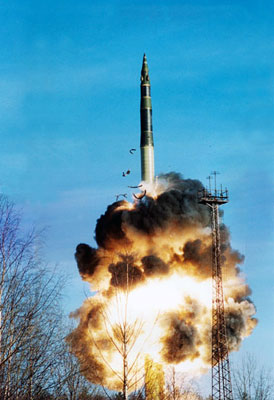
nuke.jpg

Die Versuche, die Verbreitung militärisch-nuklearen Wissens und dessen Nutzung zum Bau nuklearer Sprengkörper durch rechtliche Barrieren − das Nichtverbreitungsregime NPT 1970/1995 − aufzuhalten, kann als gescheitert angesehen werden. Zwar wurden die atomaren Diffusionsprozesse verlangsamt, aber die Dämme drohen nunmehr zu brechen. Das militärische Arsenal Nordkoreas und die mutmassliche militärische Nuklearoption Irans werden vermutlich regionale nukleare Rüstungswettläufe auslösen, aus denen nahezu zwanzig Nuklearstaaten entstehen werden.

Die militärische counter-proliferation als alternativer Schutzmechanismus gegen nukleare Aufrüstung neuer Staaten stösst in vielen Fällen an enge Grenzen: unbekannte, unterirdische oder verbunkerte nukleare Anreicherungs- und Wiederaufbereitungsganlagen, militärische Eskalationsgefahren konventioneller und nuklearer Art zählen zu den vorrangigen militärischen Risiken und Schwächen. Präzisionsschläge gegen bekannte Ziele zerstören nicht das nukleartechnische Wissen und können den Nuklearisierungsprozeß daher lediglich verzögern. Die nukleare Entwaffnung − die Zerstörung von nuklearen Fähigkeiten (capabilities) − ist ohne die Änderung des Regimes und damit seiner Absichten (intentions) nutzlos. Militärische Gegenproliferation muss daher immer den Regimewechsel als ultimatives politisches Ziel enthalten − wenn es nicht nur um letztlich unsicheren Zeitgewinn gehen soll. Regimewechsel, die in vielen Fällen massive militärische Bodenoperationen mit kosten- und zeitintensiven Stabilisierungsaufgaben einfordern, überdehnen aber verfügbare westliche Ressourcen.

Der Erwerb eines militärischen Nukleararsenals durch einen neuen Staat verändert jedenfalls die strategische Lage aller angrenzenden Staaten. Diesen stehen letztlich nur zwei Optionen offen, darauf zu reagieren − selber nuklear militärisch aufzurüsten oder aber unter den nuklearen Schutzschirm der bestehenden Nuklearmächte einzutreten.

Die letzte Option ist nicht in allen Fällen bedingungslos möglich und politisch unsicher. Wie die Abkehr der USA von der Strategie der massiven Vergeltung innerhalb der NATO intensive Debatten über das amerikanische commitment zur nuklearen Verteidigung des westlichen Europa auslöste, können die Anrainerstaaten neuer nuklearer Mächte auch nicht sicher auf den nuklearen Schutzschirm anderer Staaten, allen voran der USA, zählen.

Die Logik der neuen strategischen Lage bei vorhandenen technischen Kenntnissen und den materiellen Voraussetzungen zum Bau nuklearer Waffen (hochangereichertes Uran, Plutonium) ist für die Anrainerstaaten neuer Nuklearmächte angesichts nicht ausreichend funktionsfähiger Raketenabwehrsysteme die atomare Selbstaufrüstung.

Der Dammbruch im Nichtverbreitungsregime wird damit nahezu unweigerlich zur Proliferation nuklearer Waffen in grossem Masstab führen. Das westliche Interesse bedarf daher einer grundsätzlichen Revision: Nachdem die Verbreitung nuklearer Waffen nicht mehr zu verhindern ist, muss die nukleare Bewaffnung jener Staaten gefördert werden, die den westlichen Interessen- und Wertekanon teilen. Die Förderung nuklear bewaffneter Bündnispartner ist eine logische Folge einer grundsätzlichen Erkenntis: nicht die nuklearen militärischen Fähigkeiten eines Regimes sind die zentrale Gefahr, sondern die Absichten eines derart bewaffneten Regimes. Nukleare Waffen im Arsenal feindseliger, internationale Normen brechender, nach innen repressiver und grundsätzlich nach aussen aggressiver Terrorstaaten sind eine massive Bedrohung. Wenn diese Entwicklung aber weder rechtlich noch militärisch einzuhegen ist, bleibt als strategische Konsequenz nur die nukleare Aufrüstung der Staaten übrig, deren Absichten defensiv und mit den Interessen des Westens vereinbar sind und die über rechtsstaatlich-demokratische Mindeststandards verfügen. Die nukleare Bewaffnung befreundeter Regime verstärkt die Verteidigungskraft gegen nuklear bewaffnete Feindstaaten und − wenn die strategische Kultur der nuklearen Abschreckung als erlern- und nachahmbar angesehen wird − auch die Sicherheit der liberalen Demokratien. Zugleich ist die nukleare Abrüstung der offziellen (westlichen) Nuklearmächte derzeit als sicherheitsgefährdend anzusehen. Wenn die Staatenwelt nicht nuklearfrei sein kann, dann muss sie voll von Nuklearwaffen sein.

Diese Kommentar ist in der Zeitung ‘Die Presse’ am 5. Dezember 2006 exklusiv erschienen.

Trading Values for Gas

russia_gas.jpgIn recent months we have witnessed a fierce debate among scholars and politicians on the relations of the European Union with Russia. Two camps have emerged putting different emphasis on political conditionality, i.e. deepening the ties to the degree Russia implements democratic reforms and respects human rights and the rule of law.

Both positions do have its merits, but according to my view the EU should not mix vital interests in certain policy areas with human rights issues.

Any comment on these issues has to answer three questions. The first relates to the current state of affairs in Russia. Russia has developed over the past years into an authoritarian regime with the presidency abandoning all the constraints on its authority. While the 1993 constitution had made the presidential executive the powerhouse of the regime, the authority of Yeltsin had always been limited: Yeltsin never commanded a majority in the State Duma, the regions became increasingly assertive, pluralist albeit not free media put limits on Yeltsin’s reign and Yeltsin’s various illnesses kept him from daily political business.

Putin has done away with it all: Russia is recentralized, parliament has been transformed into a rubber-stamp organ, the electronic media renationalised or under control of state majority-owned companies like Gazprom, the state is encroaching on NGO’s and the courts remain under political control.

Putin’s rule is based on both economic liberals he had got acquainted with while he served in the city administration of Saint Petersburg and on security service personnel who had been on Putin’s side as a KGB/FSB-agent. In the second term the siloviki have encroached on the liberal camp and seem to dominate the ruling elites ever more. In addition to political offices they control the commanding heights of Russia’s economy: the oil and gas sector, the armaments industry, aircraft, steel and aluminium companies among others.

Putin’s Russia has turned into a police state where security personnel controls almost any social actor. Russia has turned into an authoritarian regime (with its limits defined by incompetence rather than by design).

This leads us to the second question: Does the EU have any strong instruments at hand to influence the domestic developments in Russia. Russia’s current political elite is highly ignorant of outside criticism; its leaders display growing self-confidence and assertiveness and brush aside outside complaints.

What is more important, however, is the fact that Russia lacks democratic features both on the supply and the demand side. As to the supplies: Russia does have numerous democratic and liberal forces; however, they have so far failed to unite in a single camp due to personal rivalries and animosities, ambition and vanity, less so due to ideological differences. Thus Russia does not have a united democratic front to challenge the regime. Russia’s political stage is monocentric – there is no one besides Putin, no one who could challenge his rule; he is without any rival or competitor.
But Russia lacks democracy also from the demand side. Russian society longed for stability, order and modest prosperity when Putin took over. A great majority had been tired of the economic decline, the social deprivation, the corruption, political clashes and semi-criminal privatisations in the nineties.

Democratization, therefore, is not on the top of Russian society’s agenda. Aside from small liberal-minded minorities – urban, educated and (moderately) wealthy people – there is not much demand for democratic rule.

Finally, EU governments and the US have lost most of their credibility with the Russians. These countries are perceived as collaborators of the Russian elite that looted Russia in the nineties.

Now, what does this mean for the relations of the EU with Russia: A realist approach recommends frank criticism to be levelled against the Russia ruling elites for transforming Russia into a police state. However, neither the EU nor the US should give in to the illusion this might have any impact on Russia’s domestic politics.

If it is useless anyway, the EU must not sacrifice vital interests in its relations with Russia for political conditionality reasons. This is particularly true for its energy relations with Russia. As of today, 25 per cent of EU-25 gas consumption is Russian gas, 26 per cent of its crude oil consumption is Russian oil. The EU’s dependence on imports of these energy carriers will increase dramatically over the next years. In 2025 the EU will have to import 90 per cent of its oil demand, and 80 per cent of its gas needs. This is due to growing demand, declining gas and oil extraction within the EU, insufficient measures to increase energy efficiency and make greater use of renewables and nuclear power.

Taking energy security serious the EU must diversify both her energy carriers and her energy suppliers. Among those relevant for Europe are Iran, Saudi Arabia, Libya, Algeria or Nigeria. All of these countries are even less democratic than Russia. Should Europe refrain from importing any gas from authoritarian regimes?

In addition, global competition for scarce energy commodities will radically increase. China, India, the US, Japan and the EU will increasingly fight for the same extraction sites. Russia therefore remains an important energy partner for the EU. It is however far from certain, that Russia will be able to satisfy EU demand for gas in the future. Energy agencies warn of a looming supply crunch with gas in 2010/2011. EU demand and Russian domestic demand for gas is growing faster than Gazprom is able to boost its production. Gazprom is not investing sufficient funds into the exploration and exploitation of new gas fields and repairing the ageing pipeline network. According to IEA assessments Russia needs to invest as much as 30 Bln. USD in the gas sector per year to sustain current production volumes.

Furthermore, Russia is currently waging options for alternative markets. As of today the oil and gas pipeline net is oriented towards European markets. This could change within a decade. Russia is heading for East Asian markets – China, Japan and Korea – and, using LNG, for Northern America.

The EU therefore needs to establish sound relations with Russia in the energy sector in order to meet its vital interests. In this regard, the Polish veto against the initiation of negatiotiations between the EU and Russia on a new framwork document for bilateral relations is political blunder. Political conditionality puts strategic objectives to risk. Therefore, it is highly questionable, even irresponsible, to mix up human rights issues with energy.

This blog was published on December 20th exclusively on Johnson’s Russia List # 285 and on www.russiaprofile.org.

NATO: Out of business while out of area

isaf.jpg

In the nineties Senator Richard Lugar made his seminal statement about NATO going either out of area or out of business. Lugar was totally right – then. NATO had to accept new commitments beyond its territory, proliferate stability, enforce peace and enable civic actors to engage in post-conflict peace building were it to sustain its legitimacy. NATO since then has been of vital importance with SFOR in Bosnia-Herzegovina, with KFOR in Kosovo and, most recently, with ISAF in Afghanistan.

ISAF is faced with growing resistance and ever more brazen attacks by restrengthened Taleban fighters. NATO allies like the UK, Canadian, Danish and Dutch squadrons take over greatest risk in surpressing the insurgency in the south, US troops in the east of Afghanistan.

All these nations suffer huge losses in order to promote the collective mission of NATO. Major allies like France, Germany, Italy and Spain however, are avoiding prolonged and regular commitment to support allies in the demanding task of crushing emboldened Taleban fighters. France is even about to withdraw its special forces within ‘Enduring Freedom’ from Afghanistan. All of them cite their allegedly essential missions in both the north and the west of Afghanistan and in Kabul. Withholding support, however, seriously undermines allied solidarity and widens the rift within NATO. Domestic considerations and lack of political will must not undermine the military logic of NATO’s ISAF engagement.

At the end of the day, ISAF commitment is about fighting; fighting with most modern equipment provided for and financed by all NATO allies. Any member country which withholds essential support for the mission is undermining cohesion within the alliance.

Furthermore, restrained engagement seriously weakens the fighting capability and efficiency of NATO in Afghanistan. It is true that ISAF together with Provincial Reconstruction Teams has to provide the infrastructural rebuilding of Afghanistan by making the environment secure and safe; war fighting, however, is still the crucial prerequisite for achieving these civil purposes. Lack of allied cohesion may risk alliance failure in defeating the insurgency. If NATO does not prevail in Afghanistan, were even to shamefully retreat from Afghanistan, NATO’s credibility will be irreversibly wrecked.

Given the current backsliding of major NATO members like France and Germany NATO risks going out of business because of going out of area.

The Litvinenko Murder

Litvinenkp

The murder of the former FSB agent A. Litvinenko is a heinous crime. The substance used – Polonium 210 –, causing a slow and painful death, indicates that the perpetrators were vying for utmost public attention. Otherwise Litvinenko could have simply been gunned down by contract killers. In addition, the murderers deliberately left a trail implicating a direct Russian involvement, particularly the traces of Polonium found in planes used for Russian destinations. Furthermore, these many places with Polonium contamination are meant to disguise the professionalism of the perpetrators; the murderes had every interest to leave the impression of highly unprofessional killers, unable to handle the deadly substance. This allows to presume, that the murderers had great interest in damaging the reputation of those Russian circles perceived as the masterminds of this plot by both Western elites and public opinion.

Basically there are three main explanations (and one rather remote) for the flagrant killing of A. Litivinenko. The first one relates this crime to President Putin personally. This is the least likely explanation, as the murder seriously tarnishes the image of Putin; the anti-Putin hysteria in the West is already utterly stong. Putin does not obtain any relevant gain by this murder; it has the potential of making him a pariah among statesmen and it may complicate his most important current objectives: the ratification of Russian WTO accession by the US congress and the initiation of a new legal co-operation framework with the EU. Besides, the murder of a second-rank security agent would maybe have made sense in 2002, when he publicly accused Russian FSB units (even Putin himself) of having bombed its own people for the sake of proliferating a pretext for the military onslaught on Chechnya. Now, given Litvinenkos limited relevance, his murder is totally unreasonable for Putin.

The second more likely explanation is that a rogue unit of the Russian domestic security service FSB is responsible for the killing. Former colleagues of Litvinenko could have taken revenge for his defection and/or wanted to kill him because he may have obtained compromising material on the FSB regading the 1999 apartment bombings and/or the murder of Anna Politkovskaya. This raises serious concerns about Putin’s ability to keep full control of the Russian security services. The very means used to execute Litvinenko, however, undermines the likelihood of this explanation.

Another motive could be domestic considerations, as various factions of the FSB have different intentions regarding the Russian election cycle in 2007 and 2008. This may well be related to the issue of the Putin succession in 2008. Circles around crown prince D. Medvedev could well be trying to discredit security services linked to his main rival for the Russian Presidency in 2008 – Defence minister S.Ivanov. These people aim to force Putin – with his reputation utterly tarnished – to reign in on the security services and weaken them decisively.

Another goal of a rogue FSB unit could be the radical destabilization of Russia from within. This unit might well have contacts to a camp within the Presidential Administration. The ultimate goal of this group was to create a situation forcing Putin to declare a state of emergency, which could lay the foundations for an extension of Putin’s presidency, the suspension of presidential elections or the constitutional changes required for a third consecutive term for Putin. Anyway, the more Putin’s reputation abroad is damaged the more he might be inclined to promote constitutional change to remain in office, since he does no longer need to take world opinion into account. In addition, further pressure on Putin to remain in office and stay the course could be alleged compromising material held by the agencies.

The third explanation, no less likely than the second one, is that Litvinenko’s patron Boris Berezovsky may have ordered his killing. Berezovsky’s principal aim is to harm Putin’s image; he has done so since being forced into exile in 2000. Berezovsky may even have access to Polonium, as he still maintains excellent relations with the security service of the Russian General staff GRU. Berezovsky may have thus even murdered one of his associates, in order to wreck Putin’s reputation. Rumours related to this consider it possible, that Litvinenko was involved in building a dirty bomb to be transferred to terrorist Chechen units – to which Berezeovsky allegedly has had close contacts for years – and accidentally poisoned himself. This, however, is utterly unlikely.

It is highly likely that we will see further events harming Putin’s reputation – further killings, poisonings, maybe even some staged low-scale terrorist attacks. As of today, it is unknown whether former acting Prime Minister Gaydar has been a poisoning victim as well. It is to be considered as highly unlikely though.

Putin may however seek to withstand the pressure and turn against the security services, weaken their influence and promote the liberal camp within his administration. The most likely steps taken by Putin in this scenario would be the dismissal of the Fradkov government and the appointment of Dmitry Medvedyev as the new head of government. Within the presidential administration one could expect the demotion of the two main FSB representatives Igor Sechin and Viktor Ivanov.

Finally, there is a remote possibility of Western security services being involved in the poisoning effort. There are circles in some countries who do have a multiple interest in discrediting Russia and her leadership.

If it were true, however, that the series of killings was the result of clashes within the Putin camp, Russian politics will become highly unstable. EU’s and US relations with Russia should therefore prepare for highly conflictual and hardly calculable times.

Further concern causes the fact of the contamination of people that had contact with Litvinenko after his presumed poisoning. The news that the Italian contact-man Scaramella has also been exposed to and affected by the toxic substance causes unease; it is also unknown as of today if the two Russians – Andrey Lugovoi and Dmitri Kovtun – who had met Litvinenko on November 1st, have been contaminated as well. Allegations Scaramella might have exposed Litvinenko to Polonium makes the whole crime even more mysterious and raises concerns about low-yield nuclear terrorism. This murder may well be among the first terrorist attacks involving radioactive material. This in itself makes it a remarkable event.

This blog comment was published exclusively on December 4th, 2006 on Russia Profile.org under the title: ‘Conspiring to Theorize. Three Explanations for the Murder of Alexander Litvinenko.